
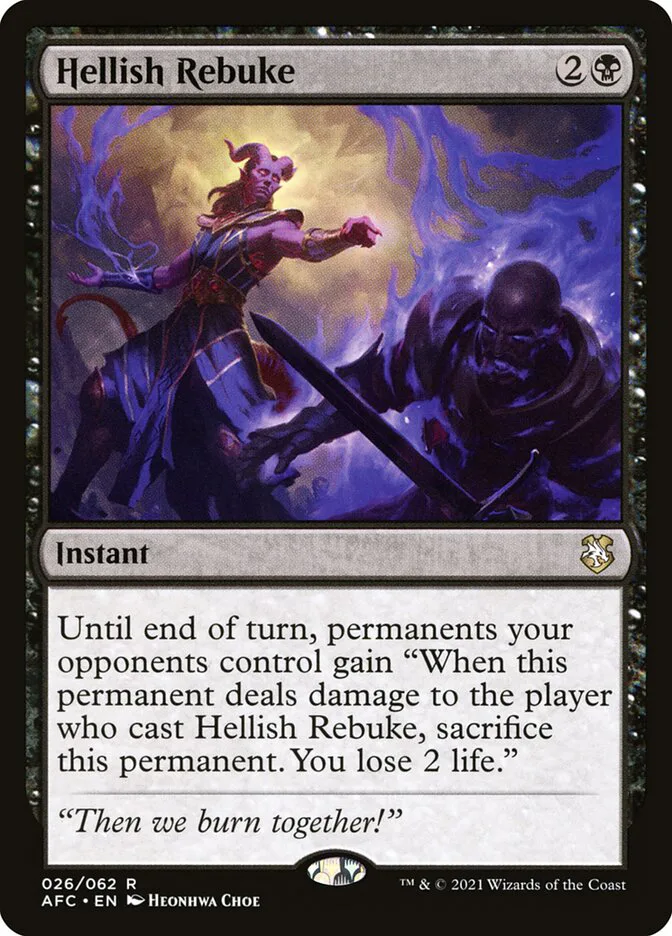
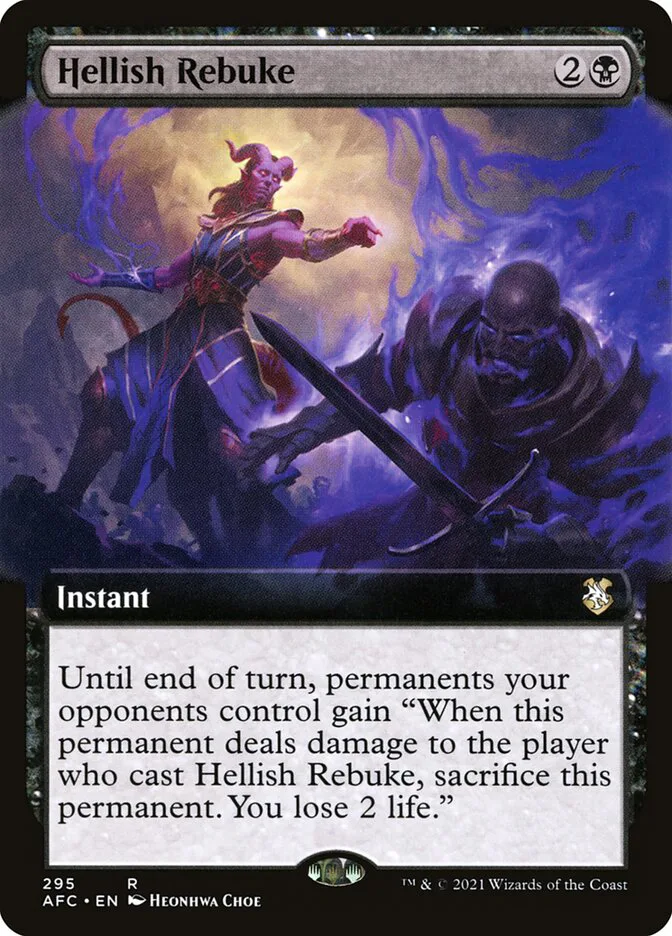
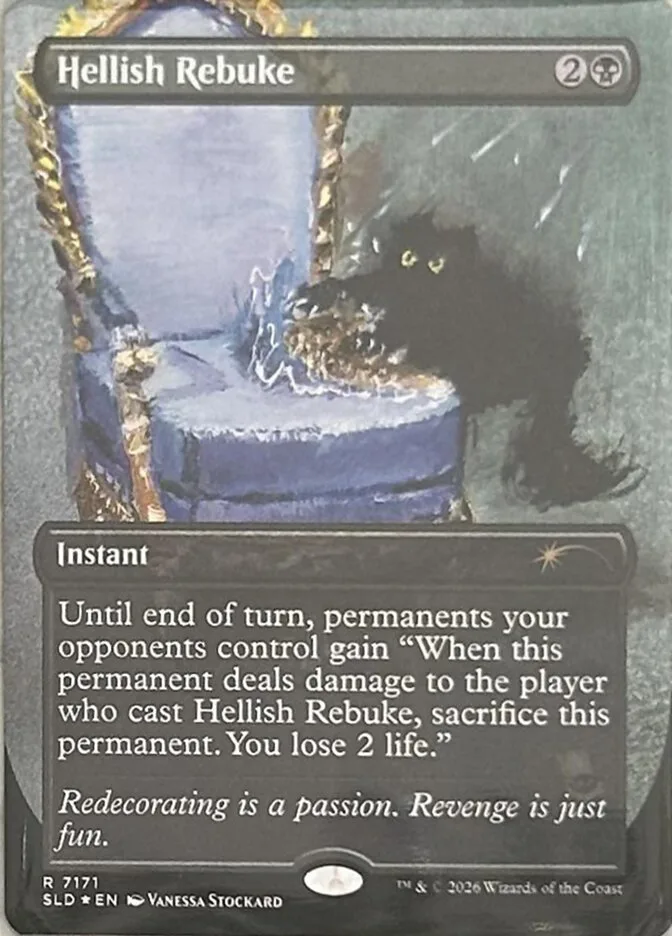
Until end of turn, permanents your opponents control gain "When this permanent deals damage to the player who cast Hellish Rebuke, sacrifice this permanent. You lose 2 life."
When the triggered ability that Hellish Rebuke grants permanents resolves, if that permanent's controller can't sacrifice it, they will still lose 2 life. Similarly, if they can't lose life, they will still sacrifice the permanent.
2021-07-23
wotc
If more than one player casts Hellish Rebuke in a turn, some permanents will gain multiple instances of the triggered ability that refer to different players. Each will trigger only for the player who cast the Hellish Rebuke that granted it the ability.
2021-07-23
wotc
If a spell or ability causes another player to gain control of Hellish Rebuke while it is on the stack, permanents controlled by the opponents of that player will gain the ability (probably including permanents you control). However, you're still the player that cast Hellish Rebuke, so the ability will trigger whenever one of those permanents deals damage to you, not the player who controlled Hellish Rebuke as it resolved.
2021-07-23
wotc
If a player casts more than one Hellish Rebuke in a turn, permanents will gain multiple instances of the triggered ability. Each will trigger and resolve separately. For instance, if you cast Hellish Rebuke twice, each permanent which damaged you will cause its controller to lose 4 life.
2021-07-23
wotc
Copies of Hellish Rebuke that weren't cast will give opponents permanents the ability, but that ability won't do anything because no player cast that copy of Hellish Rebuke.
Format Legality
Standard
Not Legal
Future
Not Legal
Historic
Not Legal
Timeless
Not Legal
Gladiator
Not Legal
Pioneer
Not Legal
Modern
Not Legal
Legacy
Legal
Pauper
Not Legal
Vintage
Legal
Penny
Not Legal
Commander
Legal
Oathbreaker
Legal
Standardbrawl
Not Legal
Brawl
Not Legal
Alchemy
Not Legal
Paupercommander
Not Legal
Duel
Legal
Oldschool
Not Legal
Premodern
Not Legal
Predh
Not Legal
Who's Online
Live site activity across collectors, guests, and crawlers.