
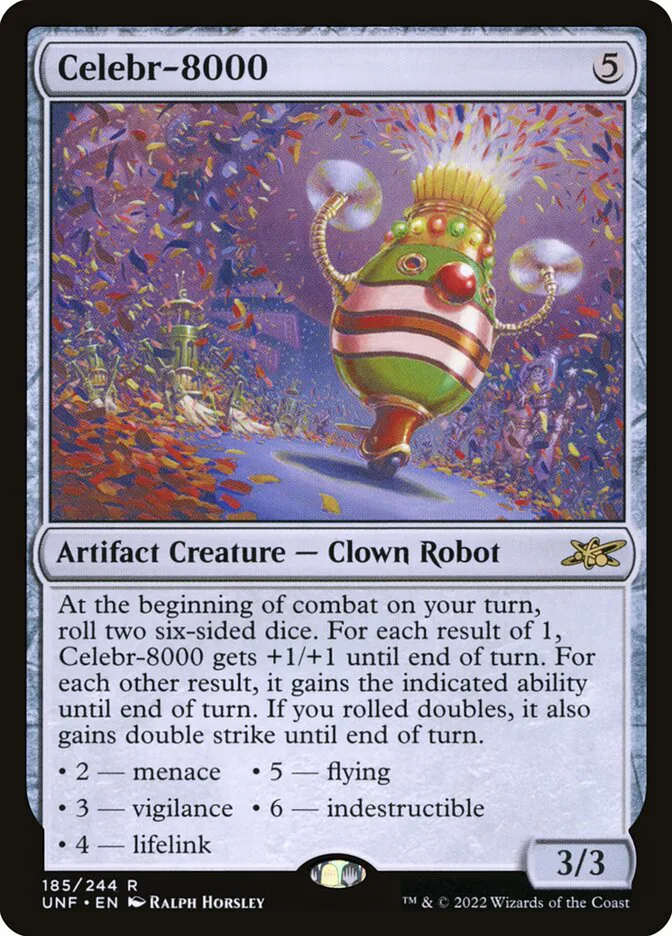
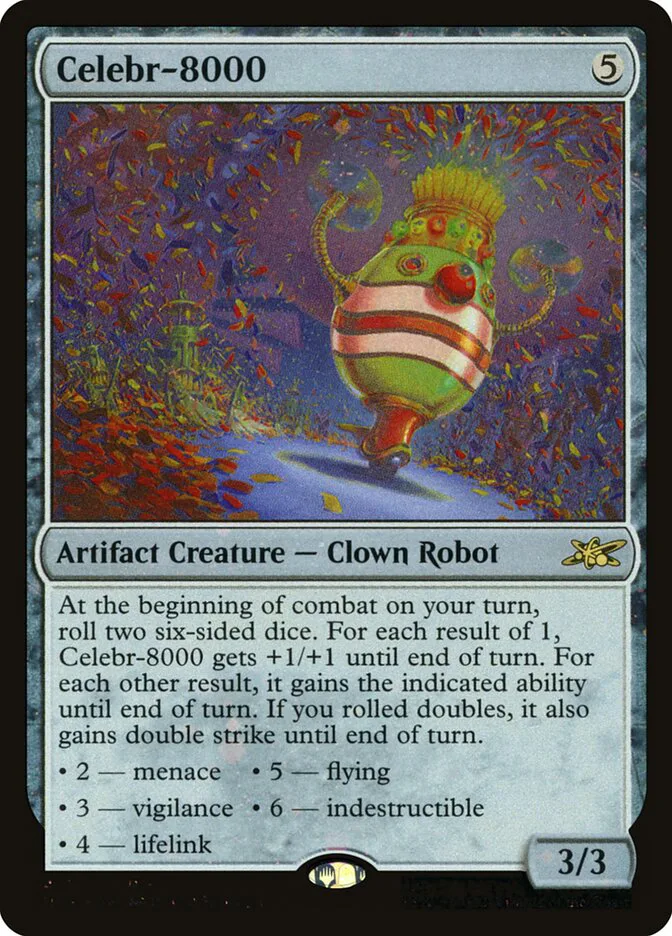
At the beginning of combat on your turn, roll two six-sided dice. For each result of 1, this creature gets +1/+1 until end of turn. For each other result, it gains the indicated ability until end of turn. If you rolled doubles, it also gains double strike until end of turn.
Something in the game must tell you to roll a die. If you roll a die for any other reason (to simulate a coin flip, to choose pizza toppings, to create alternate timelines), that roll doesn't count.
2022-10-07
wotc
Some effects may modify the result of a die roll. This may be part of the instruction to roll a die, or it may come from other cards. Anything that references the "result" of a die roll is looking for the result after these modifications.
2022-10-07
wotc
Results can be numbers not ordinarily possible on a six-sided die. Spells like Scooch can change the result to 0 or 7, for example.
2022-10-07
wotc
If you roll a result higher than 6 because of modifications to the results, Celebr-8000 won't gain any ability from that roll. If you roll doubles of such a number, it will still gain double strike until end of turn.
2022-10-07
wotc
If an ability triggers "whenever you roll a die," it will trigger whenever you roll any die, including the planar die. This is a change from previous Un- rules. Some abilities use the result to determine part of the effect. If you get a non-numerical result (currently just the planar die, but the future is long), that part of the effect won't do anything.
2022-10-07
wotc
If a die is rerolled, the original roll essentially never happened: it doesn't cause any abilities to trigger, and no effect that cares about die rolls will consider it.
2022-10-07
wotc
Each die is identified by the number of faces it has. A six-sided die is a die with six equally likely outcomes: 1, 2, 3, 4, 5, and 6. The roll must be fair. Although physical dice are recommended, digital substitutes are allowed except in cases where the physical die is required for the effect.